
Journal · Pilates
Back pain from sitting at a desk: what actually helps
Eight hours on a laptop in a Canggu café feels like nothing. Then you stand up and your lower back tells a different story. Here is what is going on, and what a little regular movement changes.
In short. Desk back pain is less about sitting "wrong" and more about sitting still for too long: research finds no clear link between posture and back pain. What helps is moving often during the day and strengthening the body regularly. Exercise reduces chronic lower back pain, and Pilates ranks among the most effective types of exercise for it in large reviews. Two to three sessions a week is a realistic start.
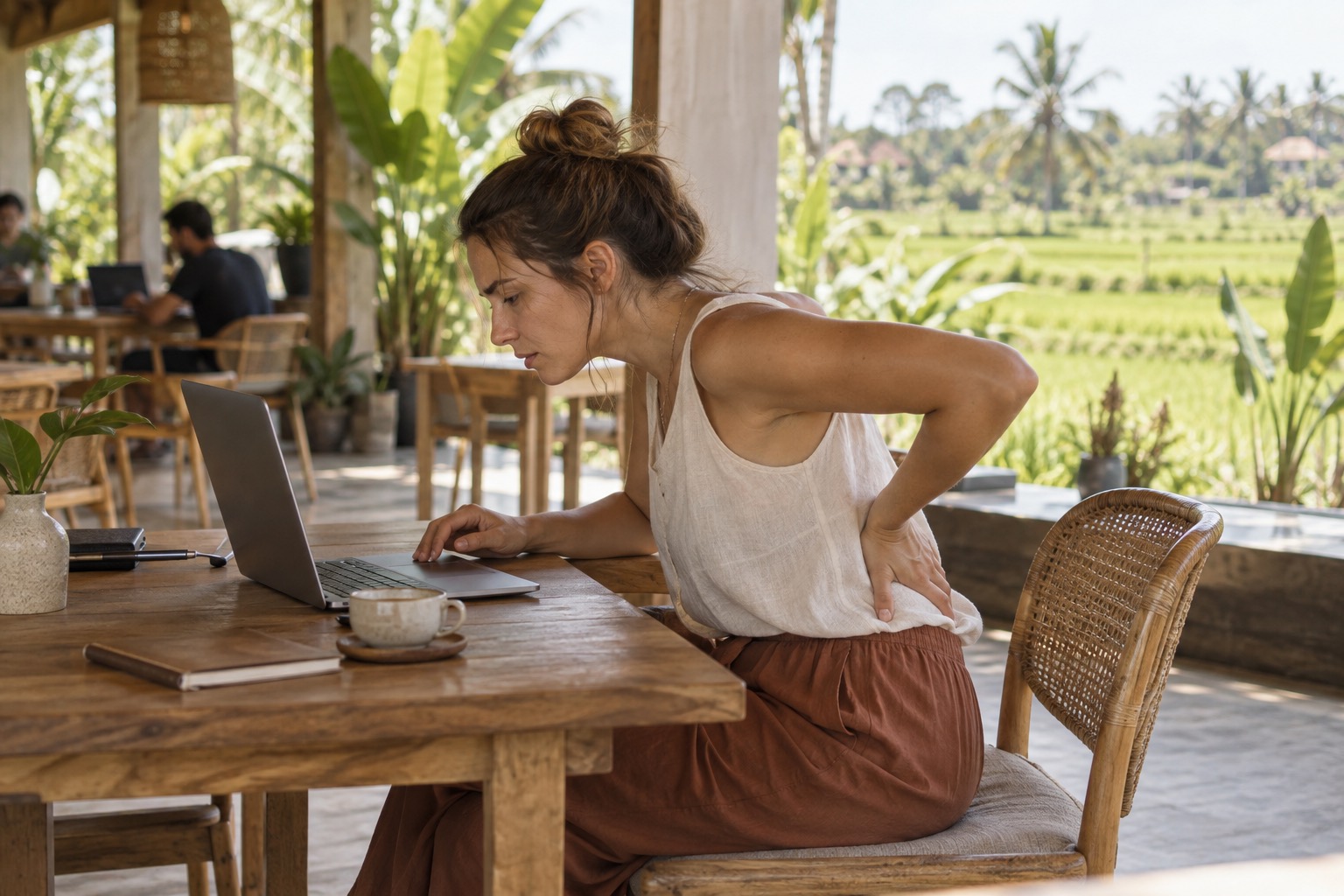
It is not the chair. It is the stillness.
Most people blame their posture, the chair or the laptop. Those feel obvious, but the research is less clear than you might think. A widely cited review found no consistent difference in posture between people with and without back pain (JOSPT, 2019). There is no single "correct" way to sit.
What the evidence points to instead is time without movement. Your back is built to change position all day. A long work session asks it to hold one shape for hours, and the muscles, joints and discs around your spine do better with variety. Stiffness when you finally stand up is often your body asking for that variety, not a sign that something is damaged.
Low activity overall plays a part too. When most of the day is spent sitting, the muscles that support and move the trunk and hips get very little work, and a body that is not used to load tends to feel it more when you do ask something of it.
Why working from Bali can make it worse
Bali is a wonderful place to work, but the setup rarely helps. Low café tables, rattan chairs, a laptop on your knees in a villa, long days in coworking spaces in Canggu and Berawa, scooter rides to Umalas or Seminyak. Add a few long flights a year and the midday heat that makes you want to move less, and your back gets very little variety.
The good news is that none of this needs a perfect desk. It needs movement, done regularly.
Three habits that help today
- Change position every 30 to 45 minutes. Stand up, walk to refill your water, stretch your arms overhead. The best posture is the next one.
- Make the screen easy to see. A stack of books under the laptop and a separate keyboard mean you are not stuck in one cramped position for hours. Comfort, not a perfect angle, is the goal.
- Move your body every day. A walk, a swim, a class. Regular activity is one of the most reliable ways to keep a back comfortable over time.

Where Pilates comes in
Exercise is one of the best-supported treatments for chronic lower back pain. A Cochrane review of 249 trials found that it reduces pain compared with no treatment or usual care, with a modest effect (Cochrane, 2021). When researchers compared types of exercise against each other, Pilates came out among the most effective for pain and function (JOSPT, 2022).
Pilates suits people who sit all day because it is low impact and precise. On a Reformer, the springs support you and resist you at the same time, so you can build strength around the trunk and hips with control, at a level that matches your body. At Reformer Pilates in Umalas, a class for a desk worker typically includes:
- Spine articulation. Bridges and roll downs get the spine moving segment by segment, the opposite of hours in one position.
- Trunk strength. Deep abdominal and back work, so the whole body shares the load.
- Hip mobility. Footwork and leg circles move the hips through the range a day of sitting rarely uses.
- Upper back and shoulders. Rowing and arm work on the straps, for the area that tightens most after a day on a laptop.
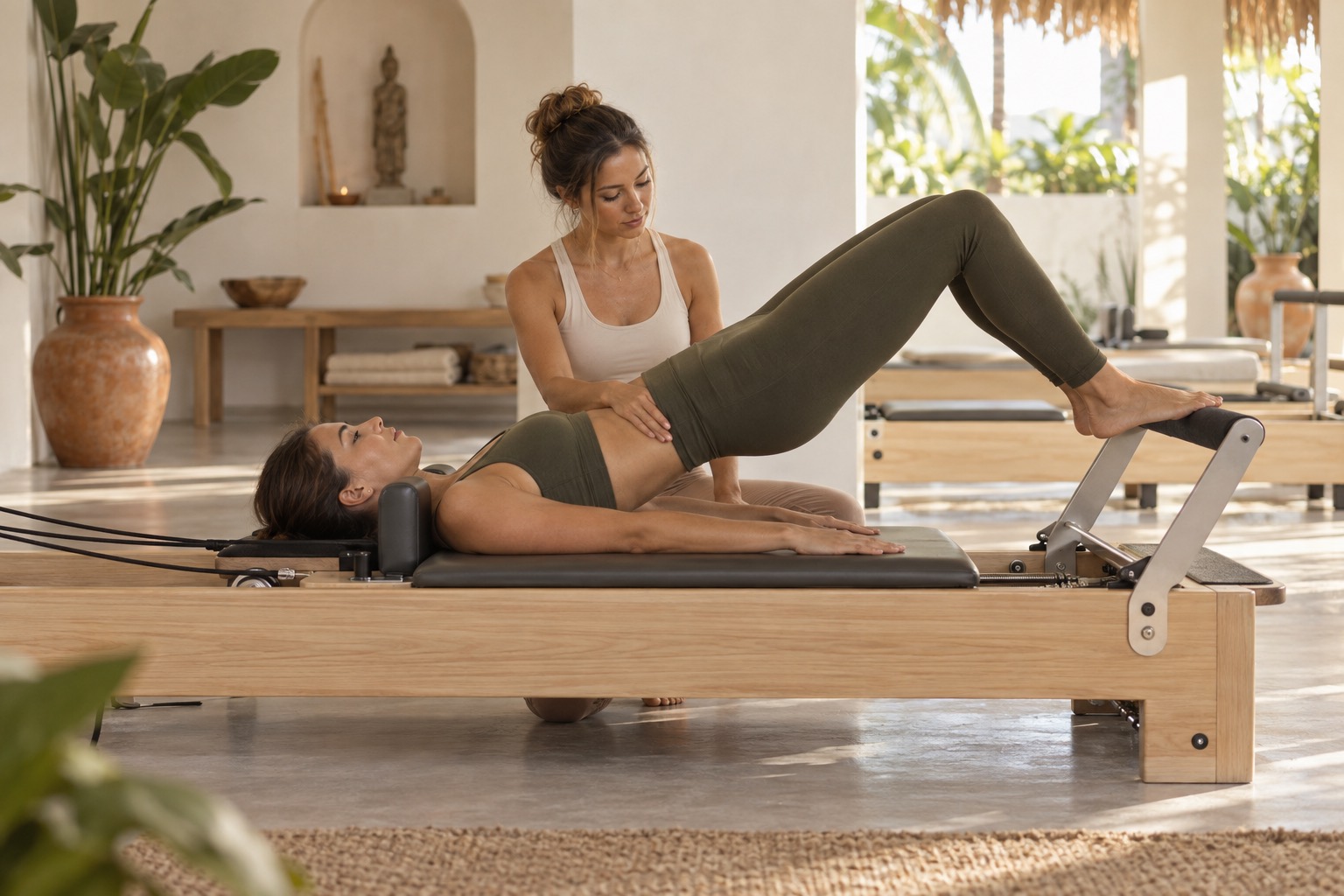
Heat can make it more comfortable too. Our Hot Mat classes run in a warm room, which many people find makes stiff muscles feel easier to move. After class, the sauna in our Recovery Club is a simple way to wind down after a long workday.
How often is enough?
Consistency beats intensity. Two to three classes a week is a realistic rhythm for most people who sit for work, and many feel less stiff within a few weeks. If you are new to Pilates, start on the Reformer: the springs make the first classes accessible, and our instructors adapt every movement to you. See prices and first-visit offers.
Questions we often hear
Is Pilates good for lower back pain?
For most people with ongoing, non-specific lower back pain, yes. Exercise reduces chronic lower back pain, and Pilates ranks among the most effective types of exercise in comparative reviews. The effect is real but modest, and it builds with regular practice.
Is sitting actually bad for my back?
Sitting itself is not harmful. Sitting for long stretches without moving is what tends to leave the back stiff and sore. Breaking up long sessions and staying active overall matters more than finding a perfect posture.
Reformer or mat, which is better for a sore back?
Both work. The Reformer's springs support you and let the instructor adjust the resistance, which many beginners and people with a sensitive back find easier to start with. Mat work builds the same control with your body weight.
How many sessions a week should I do?
Two to three sessions a week is a good starting point. Regularity matters more than intensity.
Can I do Reformer Pilates with a disc problem or sciatica?
Talk to your doctor or physiotherapist first, then tell your instructor before class so the exercises can be adapted. We do not treat injuries, and Pilates is not a substitute for medical care.
When should I see a doctor about back pain?
See a doctor promptly if your pain follows a fall or injury, comes with fever, numbness around the groin or buttocks, weakness in a leg, or problems controlling your bladder or bowel, or if it keeps getting worse. Pain that spreads down a leg is also worth having checked.
This article is general information, not medical advice. If your back pain is severe, follows an injury or comes with any of the warning signs above, see a doctor or physiotherapist before starting a new exercise routine, and tell your instructor before class.
Your desk will still be there after class.
Reformer and Hot Mat Pilates all week at MOJO Bali, Jl. Umalas II No. 85, between Canggu and Seminyak.